MI SSL API
REVISION HISTORY
| Revision No. | Description |
Date |
|---|---|---|
| 1.0 | 09/12/2020 | |
| 1.1 | 10/15/2020 | |
| 1.2 | 11/03/2021 |
1. Overview
1.1. Algorithm Description
SSL (short for Sound Source Localization) is used to locate the direction of the sound.
1.2. Keyword
When the distance between the two microphones is 5cm, the following figure describes the definition of the sound direction:
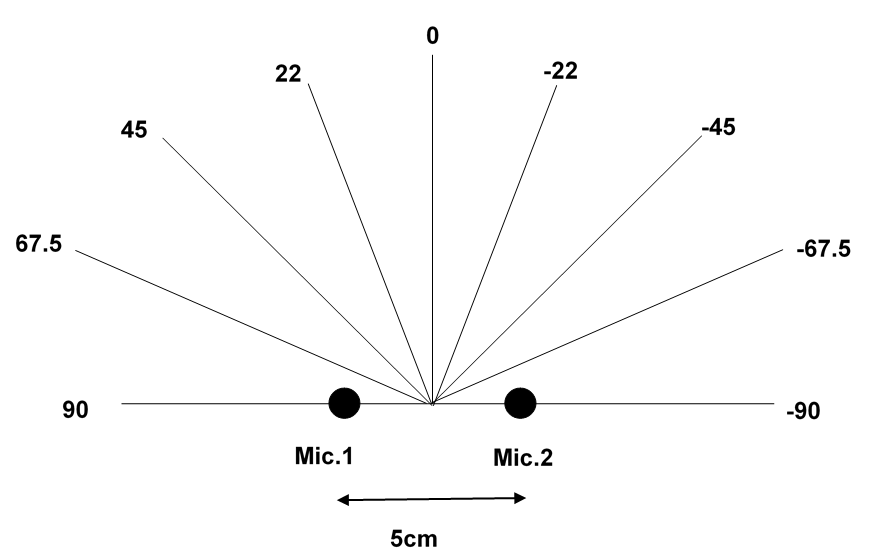
When the number of microphone is more than two, there are two possible configurations for the corresponding microphone array system: Uniform Linear Array (ULA) or Uniform Circular Array (UCA).
1.3. Note
1.3.1. Implementation
In order to facilitate debugging and confirm the effect of the algorithm, the user application needs to implement replacement algorithm parameter and grab audio data.
1.3.2. Correspondence
Different channel numbers will correspond to different reference libraries. The user needs to confirm whether to use the correct number of channels and the corresponding reference library.
2. Coordinate system of Microphone Array
2.1. Multichannel Microphone array
There are two main types of multichannel array system used in practice, one is the uniform linear array, and the other is uniform circular array.
2.1.1. Uniform Linear Array
Uniform linear array is a straight line array that is spaced evenly. Because of its DOA symmetry, we only consider the sound direction locates at the upper plane (from -90 degree to 90 degree). Figure 2-1 illustrates the uniform linear array and its coordinate system. The sound direction is defined as the angle between the array center and the x-axis where counterclockwise is positive. We recommend the distance of adjacent microphones should be bigger than 5cm or 6cm.
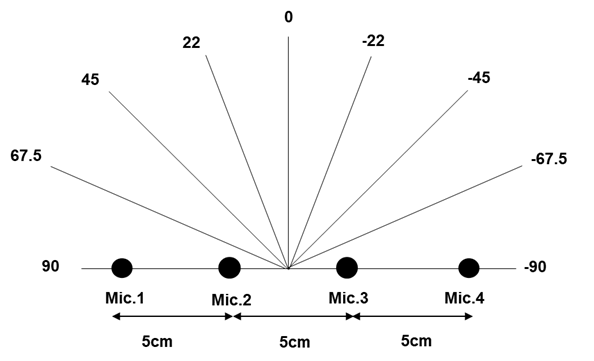
Figure 2-1: Uniform linear array and its coordinate system.
2.1.2. Uniform Circular Array
Uniform circular array is a circular array that the angle between adjacent microphones and array center are the same. Because of its DOA asymmetry, we consider the sound direction locates at the whole plane (from -90 degree to 270 degree). Figure 2-2 illustrates the uniform circular array and its coordinate system. The sound direction is defined as the angle between the array center and the x-axis where counterclockwise is positive. The distance is the diameter of the circle. We recommend the distance should be bigger than 6cm.
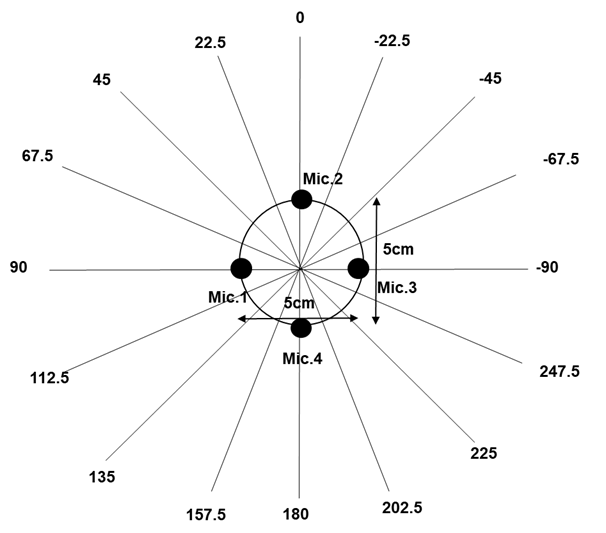
Figure 2-2: Uniform circular array and its coordinate system.
3. API Reference
3.1. API List
| API name | Features |
|---|---|
| IaaSsl_GetBufferSize | Get the memory size required for Ssl algorithm running |
| IaaSsl_Init | Initialize Ssl algorithm |
| IaaSsl_Config | Configure Ssl algorithm |
| IaaSsl_Get_Config | Get the current configuration parameter information of the Ssl algorithm |
| IaaSsl_Set_Shape | Define the type of array system belongs to either ULA or UCA. |
| IaaSsl_Cal_Params | Recalculate some parameters required for SSL algorithm according to the type of array system. |
| IaaSsl_Run | Ssl algorithm processing |
| IaaSsl_Get_Direction | Get the result direction of Ssl algorithm processing |
| IaaSsl_Reset_Mapping | Reinitialize the buffer after IaaSsl_Get_Direction. |
| IaaSsl_Reset | Reinitialize Ssl algorithm |
| IaaSsl_Free | Release Ssl algorithm resources |
3.2. IaaSsl_GetBufferSize
-
Features
Get the memory size required for Ssl algorithm running.
-
Syntax
unsigned int IaaSsl_GetBufferSize(void);
-
Return value
Return value is the memory size required for Ssl algorithm running. The memory size is dependent on the microphone number.
-
Dependency
-
Header: AudioSslProcess.h
-
Library: libSSL_2MIC_LINUX.so/ libSSL_2MIC_LINUX.a/libSSL_4MIC_LINUX.so/libSSL_4MIC_LINUX.a
-
-
Note
The interface only returns the required memory size, and the application and release of memory need to be processed by the application.
-
Example
Please refer to IaaSsl_Run example.
3.3. IaaSsl_Init
-
Features
Initialize Ssl algorithm.
-
Syntax
SSL_HANDLE IaaSsl_Init(char* working_buffer, AudioSslInit* ssl_init);
-
Parameters
Parameter Name Description Input/Output working_buffer Memory address used by Ssl algorithm.The memory address will be obtained after user applies for the memory size. Input ssl_init Ssl algorithm initialization structure pointer Input -
Return value
Return value Result Not NULL Successful NULL Failed -
Dependency
-
Header: AudioSslProcess.h
-
Library: libSSL_2MIC_LINUX.so/ libSSL_2MIC_LINUX.a/libSSL_4MIC_LINUX.so/libSSL_4MIC_LINUX.a
-
-
Example
Please refer to IaaSsl_Run example.
3.4. IaaSsl_Config
-
Features
Configure Ssl algorithm.
-
Syntax
ALGO_SSL_RET IaaSsl_Config(SSL_HANDLE handle, AudioSslConfig* ssl_config);
-
Parameters
Parameter Name Description Input/Output handle Ssl algorithm handle Input ssl_config Ssl algorithm configuration parameter structure pointer Input -
Return value
Return value Result 0 Successful Non-zero Failed, refer to error code -
Dependency
-
Header: AudioSslProcess.h
-
Library: libSSL_2MIC_LINUX.so/ libSSL_2MIC_LINUX.a/libSSL_4MIC_LINUX.so/libSSL_4MIC_LINUX.a
-
-
Example
Please refer to IaaSsl_Run example.
3.5. IaaSsl_Get_Config
-
Features
Get the current configuration parameter information of the Ssl algorithm.
-
Syntax
ALGO_SSL_RET IaaSsl_Get_Config(SSL_HANDLE handle, AudioSslConfig *ssl_config);
-
Parameters
Parameter Name Description Input/Output handle Ssl algorithm handle Input ssl_config Ssl algorithm configuration parameter structure pointer Output -
Return value
Return value Result 0 Successful Non-zero Failed, refer to error code -
Dependency
-
Header: AudioSslProcess.h
-
Library: libSSL_2MIC_LINUX.so/ libSSL_2MIC_LINUX.a/libSSL_4MIC_LINUX.so/libSSL_4MIC_LINUX.a
-
-
Example
Please refer to IaaSsl_Run example.
3.6. IaaSsl_Set_Shape
-
Features
Define the type of array system belongs to either ULA or UCA.
-
Syntax
ALGO_SSL_RET IaaSsl_Set_Shape(SSL_HANDLE handle,int shape);
-
Parameters
Parameter Name Description Input/Output handle Ssl algorithm handle Input shape The integer to decide array shape of Microphone array 0: Uniform Linear Array. 1: Uniform Circular Array. Input -
Return value
Return value Result 0 Successful Non-zero Failed, refer to error code -
Dependency
-
Header: AudioSslProcess.h
-
Library: libSSL_2MIC_LINUX.so/ libSSL_2MIC_LINUX.a/libSSL_4MIC_LINUX.so/libSSL_4MIC_LINUX.a
-
-
Note
-
Our lib only supports uniform linear array and uniform circular array (Figure 2-1 and Figure 2-2). User has to inform the modification if he/she requires special array geometry.
-
Only uniform linear array exists when there are only two microphones.
-
The settings of array position will impact largely on SSL performance. Therefore, the settings of array position must be matched to the microphone array being used.
-
-
Example
Please refer to IaaSsl_Run example.
3.7. IaaSsl_Cal_Params
-
Features
Recalculate some parameters required for SSL algorithm according to the type of array system.
-
Syntax
ALGO_SSL_RET IaaSsl_Cal_Params(SSL_HANDLE handle);
-
Parameters
Parameter Name Description Input/Output handle Ssl algorithm handle Input -
Return value
Return value Result 0 Successful Non-zero Failed, refer to error code -
Dependency
-
Header: AudioSslProcess.h
-
Library: libSSL_2MIC_LINUX.so/ libSSL_2MIC_LINUX.a/libSSL_4MIC_LINUX.so/libSSL_4MIC_LINUX.a
-
-
Example
Please refer to IaaSsl_Run example.
3.8. IaaSsl_Run
-
Features
Ssl algorithm processing.
-
Syntax
ALGO_SSL_RET IaaSsl_Run(SSL_HANDLE handle, short* microphone_input,
int *delay_sample);
-
Parameters
Parameter Name Description Input/Output handle Ssl algorithm handle Input microphone_input The microphone raw data Input delay_sample The number of delayed samples for each microphone pair. It’s recommended to be used when bf_mode is enable. Output -
Return value
Return value Result 0 Successful Non-zero Failed, refer to error code -
Dependency
-
Header: AudioSslProcess.h
-
Library: libSSL_2MIC_LINUX.so/ libSSL_2MIC_LINUX.a/libSSL_4MIC_LINUX.so/libSSL_4MIC_LINUX.a
-
-
Note
-
For dual microphone array (the microphone input is binaural data), the data pointed to microphone_input should use the sampling point as the smallest unit and be placed in the format of L,R,L,R … .The length must correspond to the point_number (the number of sampling points once Ssl process) set in IaaSsl_Init. →Example I
-
For multichannel microphone array (microphone number is bigger than two where binaural data is not enough for processing), the input data of each microphone must be mono-channel. The data pointed to microphone_input should use the sampling point as the smallest unit and be placed in the format of [Left → Right], according to the relative position. The length must correspond to the point_number (the number of sampling points once Ssl process) set in IaaSsl_Init. →Example II
-
Take microphone array in both Figure 2-1 and Figure 2-2 as example, the microphone_input should be placed in the format of [MIC1→MIC2→MIC3→MIC4].
-
-
Example
Example I: Dual Microphone array(The microphone input is a binaural audio)
1.  #include <stdio.h>
2.  #include <unistd.h>
3.  #include <fcntl.h>
4.  #include <string.h>
5.  #include <sys/time.h>
6.  #include <sys/ioctl.h>
7.  #include <stdlib.h>
8.  #include "AudioSslProcess.h"
9.
10. #define MIC_NUM (2)
11. #define USE_MALLOC   (1)
12. typedef unsigned char               uint8;
13. typedef unsigned short              uint16;
14. typedef unsigned long               uint32;
15.
16.
17. unsigned int _OsCounterGetMs(void)
18. {
19.     struct  timeval t1;
20.     gettimeofday(&t1,NULL);
21.     unsigned int T = ( (1000000 * t1.tv_sec)+ t1.tv_usec ) / 1000;
22.     return T;
23. }
24.
25. int main(int argc, char *argv[])
26. {
27.     /*******Input file init*********/
28.     short input[256];
29.     char infileName[512];
30.     char outfileName[512];
31.     FILE * fin;
32.     FILE * fout;
33.     ALGO_SSL_RET ret;
34.     int counter2 = 0;
35.     unsigned int T0,T1,T2,T3;
36.     float avg = 0.0;
37.     float avg2 = 0.0;
38.     /**********common setting SSL***************/
39.     int point_number = 128;
40.     float microphone_distance = 12.0;
41.     int temperature = 20;
42.     int sample_rate = 16000;
43.     int delay_sample[1] = {0};
44.     int shape = 0;
45.     int direction = 0;
46.     int frame_number = 32;
47.     /**************SSL data init***********/
48.     int counter = 0;
49. #if USE_MALLOC
50.     char *WorkingBuffer2;
51.     WorkingBuffer2 = (char*)malloc(IaaSsl_GetBufferSize());
52. #endif
53.     AudioSslInit ssl_init;
54.     AudioSslConfig ssl_config;
55.     SSL_HANDLE handle;
56.
57.     ssl_init.mic_distance = microphone_distance; //cm
58.     ssl_init.point_number = point_number;
59.     ssl_init.sample_rate = sample_rate;
60.     ssl_init.bf_mode = 0;
61.     ssl_init.channel = MIC_NUM;
62.     ssl_config.temperature = temperature; //c
63.     ssl_config.noise_gate_dbfs = -80;
64.     ssl_config.direction_frame_num = frame_number;
65.     /******init algorithm********/
66.     handle = IaaSsl_Init((char*)WorkingBuffer2, &ssl_init);
67.     if (handle==NULL)
68.     {
69.         printf("SSL init error\n\r");
70.         return -1;
71.     }
72.     else
73.     {
74.         printf("SSL init succeed\n\r");
75.     }
76.
77.     ret = IaaSsl_Config(handle ,&(ssl_config));
78.     if (ret)
79.     {
80.         printf("Error occured in SSL Config\n\r");
81.         return -1;
82.     }
83.     ret = IaaSsl_Set_Shape(handle,shape);
84.     if (ret)
85.     {
86.         printf("Error occured in Array shape\n\r");
87.         return -1;
88.     }
89.
90.     ret = IaaSsl_Cal_Params(handle);
91.     if (ret)
92.     {
93.         printf("Error occured in Array matrix calculation\n\r");
94.         return -1;
95.     }
96.
97.     sprintf(infileName,"%s","./../sample/data/Chn_Left_right_12_0.wav");
98.     sprintf(outfileName,"%s","./SSL_result.txt");
99.
100.        fin = fopen(infileName, "rb");
101.        if(!fin)
102.        {       printf("the input file 0 could not be open\n\r");
103.            return -1;
104.        }
105.
106.        fout = fopen(outfileName, "w");
107.        if(!fout)
108.        {
109.            printf("the output file could not be open\n\r");
110.            return -1;
111.        }
112.
113.        fread(input, sizeof(char), 44, fin); // read header 44 bytes
114.        fprintf(fout,"%s\t%s\t%s\n\r","time","direction","case");
115.        while(fread(input, sizeof(short), ssl_init.point_number*2, fin))
116.        {
117.            counter++;
118.            T0  = (long)_OsCounterGetMs();
119.            ret = IaaSsl_Run(handle,input,delay_sample);
120.            if(ret != 0)
121.            {
122.                printf("The Run fail\n");
123.                return -1;
124.            }
125.            // low resolution
126.    //      if (ssl_init.bf_mode == 1)
127.    //      {
128.    //          printf("delay_sample: %d\n",delay_sample[0]);
129.    //      }
130.            T1  = (long)_OsCounterGetMs();
131.            avg += (T1-T0);
132.            if(counter == ssl_config.direction_frame_num && ssl_init.bf_mode == 0)
133.            {
134.                counter2++;
135.                counter= 0;
136.                T2  = (long)_OsCounterGetMs();
137.                ret = IaaSsl_Get_Direction(handle, &direction);
138.                T3  = (long)_OsCounterGetMs();
139.                avg2 += (T3-T2);
140.                if(ret != 0 && ret!=ALGO_SSL_RET_RESULT_UNRELIABLE && ret!=ALGO_SSL_RET_BELOW_NOISE_GATE&&ret!=ALGO_SSL_RET_DELAY_SAMPLE_TOO_LARGE)
141.                {
142.                    printf("The Get_Direction fail\n");
143.                    return -1;
144.                }
145.                // write txt file
146.                fprintf(fout,"%f\t%d",(float)(counter2*ssl_config.direction_frame_num*0.008),direction);
147.                if (ret==0)
148.                {
149.                    fprintf(fout,"\t%s\n\r","current time is reliable!");
150.                }
151.                else if (ret==ALGO_SSL_RET_BELOW_NOISE_GATE)
152.                {
153.                    fprintf(fout,"\t%s\n\r","current time volume is too small!");
154.                }
155.                else if(ret==ALGO_SSL_RET_DELAY_SAMPLE_TOO_LARGE)
156.                {
157.                    fprintf(fout,"\t%s\n\r","current time delay_sample is out of range!");
158.                }
159.                else
160.                {
161.                    fprintf(fout,"\t%s\n\r","current time is not reliable!");
162.                }
163.                // reset voting
164.                ret = IaaSsl_Reset_Mapping(handle);
165.                if(ret != 0)
166.                {
167.                    printf("The ResetVoting fail\n");
168.                    return -1;
169.                }
170.            }
171.        }
172.        avg  = avg / (float)(ssl_config.direction_frame_num*counter2);
173.        avg2 = avg2 / (float)(counter2);
174.        printf("AVG for IaaSSL_RUN is %.3f ms\n",avg);
175.        printf("AVG for IaaSSL_GetDirection is %.3f ms\n",avg2);
176.        IaaSsl_Free(handle);
177.        fclose(fin);
178.        fclose(fout);
179.        free(WorkingBuffer2);
180.        printf("Done\n");
181.        return 0;
182.}
Example II: Multichannel Microphone array (Microphone input are 4x mono-channel audio)
1.  #include <stdio.h>
2.  #include <unistd.h>
3.  #include <fcntl.h>
4.  #include <string.h>
5.  #include <sys/time.h>
6.  #include <sys/ioctl.h>
7.  #include <stdlib.h>
8.  #include "AudioSslProcess.h"
9.
10. #define MIC_NUM (4)
11. #define USE_MALLOC   (1)
12. typedef unsigned char               uint8;
13. typedef unsigned short              uint16;
14. typedef unsigned long               uint32;
15.
16. unsigned int _OsCounterGetMs(void)
17. {
18.     struct  timeval t1;
19.     gettimeofday(&t1,NULL);
20.     unsigned int T = ( (1000000 * t1.tv_sec)+ t1.tv_usec ) / 1000;
21.     return T;
22. }
23.
24. int main(int argc, char *argv[])
25. {
26.     /*********Input file init*******/
27.     short input[512];
28.     short input_tmp1[128],input_tmp2[128],input_tmp3[128],input_tmp4[128];
29.     char infileName[MIC_NUM][512];
30.     char outfileName[512];
31.     FILE * fin0,* fin1,* fin2,* fin3;
32.     FILE * fout;
33.     int k;
34.     ALGO_SSL_RET ret;
35.     int counter2 = 0;
36.     unsigned int T0,T1,T2,T3;
37.     float avg = 0.0;
38.     float avg2 = 0.0;
39.     /********common setting  SSL ********/
40.     int point_number = 128;
41.     float microphone_distance = 4.0;
42.     int temperature = 20;
43.     int sample_rate = 16000;
44.     int delay_sample[MIC_NUM-1] = {0,0,0}; //channel-1
45.     int shape  = 0;
46.     int direction = 0;
47.     int frame_number = 32;
48.     /********SSL data init********/
49.     int counter = 0;
50. #if USE_MALLOC
51.     char *WorkingBuffer_SSL;
52.     WorkingBuffer_SSL = (char*)malloc(IaaSsl_GetBufferSize());
53. #endif
54.     AudioSslInit ssl_init;
55.     AudioSslConfig ssl_config;
56.     SSL_HANDLE ssl_handle;
57.
58.     ssl_init.mic_distance = microphone_distance;
59.     ssl_init.point_number = point_number;
60.     ssl_init.sample_rate = sample_rate;
61.     ssl_init.bf_mode = 0;
62.     ssl_init.channel  = MIC_NUM;
63.     ssl_config.temperature = temperature;
64.     ssl_config.noise_gate_dbfs = -80;
65.     ssl_config.direction_frame_num = frame_number;
66.
67.     /*******init algorithm *****/
68.     ssl_handle = IaaSsl_Init((char*)WorkingBuffer_SSL, &ssl_init);
69.     if (ssl_handle == NULL)
70.     {
71.         printf("Init fail\n\r");
72.         return -1;
73.     }
74.     else
75.     {
76.         printf("SSL init succeed\n\r");
77.     }
78.
79.     ret = IaaSsl_Config(ssl_handle ,&(ssl_config));
80.     if (ret)
81.     {
82.         printf("Error occured in SSL Config\n\r");
83.         return -1;
84.     }
85.
86.     ret = IaaSsl_Set_Shape(ssl_handle,shape);
87.     if (ret)
88.     {
89.         printf("Error occured in Array shape\n\r");
90.         return -1;
91.     }
92.
93.     ret = IaaSsl_Cal_Params(ssl_handle);
94.     if (ret)
95.     {
96.         printf("Error occured in Array matrix calculation\n\r");
97.         return -1;
98.     }
99.
100.        /********open input file and input file*****/
101.
102.        sprintf(infileName[0],"%s","./../sample/data/Chn-01.wav");
103.        sprintf(infileName[1],"%s","./../sample/data/Chn-02.wav");
104.        sprintf(infileName[2],"%s","./../sample/data/Chn-03.wav");
105.        sprintf(infileName[3],"%s","./../sample/data/Chn-04.wav");
106.        sprintf(outfileName,"%s","./SSL_result.txt");
107.        fin0 = fopen(infileName[0], "rb");
108.        if(!fin0)
109.        {
110.            printf("the input file0 could not be open\n\r");
111.            return -1;
112.        }
113.        fin1 = fopen(infileName[1], "rb");
114.        if(!fin1)
115.        {
116.            printf("the input file 1 could not be open\n\r");
117.            return -1;
118.        }
119.        fin2 = fopen(infileName[2], "rb");
120.        if(!fin2)
121.        {
122.            printf("the input file 2 could not be open\n\r");
123.            return -1;
124.        }
125.        fin3 = fopen(infileName[3], "rb");
126.        if(!fin3)
127.        {
128.            printf("the input file 3 could not be open\n\r");
129.            return -1;
130.        }
131.        fout = fopen(outfileName, "w");
132.        if(!fout)
133.        {
134.            printf("the output file could not be open\n\r");
135.            return -1;
136.        }
137.
138.        fread(input, sizeof(char), 44, fin0); // read header 44 bytes
139.        fread(input, sizeof(char), 44, fin1); // read header 44 bytes
140.        fread(input, sizeof(char), 44, fin2); // read header 44 bytes
141.        fread(input, sizeof(char), 44, fin3); // read header 44 bytes
142.
143.        short * input_ptr;
144.        fprintf(fout,"%s\t%s\t%s\n\r","time","direction","case");
145.        while(fread(input_tmp1, sizeof(short), point_number, fin0))
146.        {
147.            fread(input_tmp2, sizeof(short), point_number, fin1);
148.            fread(input_tmp3, sizeof(short), point_number, fin2);
149.            fread(input_tmp4, sizeof(short), point_number, fin3);
150.            input_ptr = input;
151.            for(k=0;k<point_number;k++)
152.            {
153.                *input_ptr =  input_tmp1[k];
154.                input_ptr++;
155.                *input_ptr =  input_tmp2[k];
156.                input_ptr++;
157.                *input_ptr =  input_tmp3[k];
158.                input_ptr++;
159.                *input_ptr =  input_tmp4[k];
160.                input_ptr++;
161.            }
162.            counter++;
163.            T0  = (long)_OsCounterGetMs();
164.            ret = IaaSsl_Run(ssl_handle,input,delay_sample);
165.            if(ret != 0)
166.            {
167.                printf("The Run fail\n");
168.                return -1;
169.            }
170.            // low resolution
171.    //      if (ssl_init.bf_mode == 1)
172.    //      {
173.    //          printf("delay_sample: %d,%d,%d\n",delay_sample[0],delay_sample[1],delay_sample[2]);
174.    //      }
175.            T1  = (long)_OsCounterGetMs();
176.            avg += (T1-T0);
177.
178.            if(counter == ssl_config.direction_frame_num && ssl_init.bf_mode == 0)
179.            {
180.                counter2++;
181.                counter= 0;
182.                T2  = (long)_OsCounterGetMs();
183.                ret = IaaSsl_Get_Direction(ssl_handle, &direction);
184.                T3  = (long)_OsCounterGetMs();
185.                avg2 += (T3-T2);
186.                if(ret != 0 && ret!=ALGO_SSL_RET_RESULT_UNRELIABLE && ret!=ALGO_SSL_RET_BELOW_NOISE_GATE&&ret!=ALGO_SSL_RET_DELAY_SAMPLE_TOO_LARGE)
187.                {
188.                    printf("The Get_Direction fail\n");
189.                    return -1;
190.                }
191.                // write txt file
192.                fprintf(fout,"%f\t%d",(float)(counter2*ssl_config.direction_frame_num*0.008),direction);
193.                if (ret==0)
194.                {
195.                    fprintf(fout,"\t%s\n\r","current time is reliable!");
196.                }
197.                else if (ret==ALGO_SSL_RET_BELOW_NOISE_GATE)
198.                {
199.                    fprintf(fout,"\t%s\n\r","current time volume is too small!");
200.                }
201.                else if(ret==ALGO_SSL_RET_DELAY_SAMPLE_TOO_LARGE)
202.                {
203.                    fprintf(fout,"\t%s\n\r","current time delay_sample is out of range!");
204.                }
205.                else
206.                {
207.                    fprintf(fout,"\t%s\n\r","current time is not reliable!");
208.                }
209.                // reset voting
210.                ret = IaaSsl_Reset_Mapping(ssl_handle);
211.                if(ret != 0)
212.                {
213.                    printf("The ResetVoting fail\n");
214.                    return -1;
215.                }
216.            }
217.        }
218.        avg  = avg / (float)(ssl_config.direction_frame_num*counter2);
219.        avg2 = avg2 / (float)(counter2);
220.        printf("AVG for IaaSSL_RUN is %.3f ms\n",avg);
221.        printf("AVG for IaaSSL_GetDirection is %.3f ms\n",avg2);
222.        IaaSsl_Free(ssl_handle);
223.        fclose(fin0);
224.        fclose(fin1);
225.        fclose(fin2);
226.        fclose(fin3);
227.        fclose(fout);
228.        free(WorkingBuffer_SSL);
229.        printf("Done\n");
230.
231.        return 0;
232.}
3.9. IaaSsl_Get_Direction
-
Features
Get the result of Ssl algorithm processing.
-
Syntax
ALGO_SSL_RET IaaSsl_Get_Direction(SSL_HANDLE handle, int* direction);
-
Parameters
Parameter Name Description Input/Output handle Ssl algorithm handle Input direction For ULA, the value is between -90~90. For UCA, the value is between -90~270. When the value is -10000, there are three possibilities. The first is that the volume is lower than noise_gate_dbfs,and the second is that the amount of data is not enough to estimate a reliable direction, and the third is that the estimation is out of range. Output -
Return value
Return value Result 0 Successful 0x10000107 Successful.Warning: The estimation is out of range. 0x10000113 Successful.Warning: The volume is lower than noise_gate_dbfs. 0x10000114 Successful.Warning: The amount of data is not enough to estimate a reliable direction. others Failed, refer to error code -
Dependency
-
Header: AudioSslProcess.h
-
Library: libSSL_2MIC_LINUX.so/ libSSL_2MIC_LINUX.a/libSSL_4MIC_LINUX.so/libSSL_4MIC_LINUX.a
-
-
Note
IaaSsl_Reset_Mapping must be called after using IaaSsl_Get_Direction.
-
Example
Please refer to IaaSsl_Run example.
3.10. IaaSsl_Reset_Mapping
-
Features
Reinitialize the buffer after IaaSsl_Get_Direction.
-
Syntax
ALGO_SSL_RET IaaSsl_Reset_Mapping(SSL_HANDLE handle);
-
Parameters
Parameter Name Description Input/Output handle Ssl algorithm handle Input -
Return value
Return value Result 0 Successful Non-zero Failed, refer to error code -
Dependency
-
Header: AudioSslProcess.h
-
Library: libSSL_2MIC_LINUX.so/ libSSL_2MIC_LINUX.a/libSSL_4MIC_LINUX.so/libSSL_4MIC_LINUX.a
-
-
Note
IaaSsl_Reset_Mapping must be called after using IaaSsl_Get_Direction.
-
Example
Please refer to IaaSsl_Run example.
3.11. IaaSsl_Reset
-
Features
Reinitialize Ssl algorithm.
-
Syntax
SSL_HANDLE IaaSsl_Reset(SSL_HANDLE working_buffer, AudioSslInit* ssl_init);
-
Parameters
Parameter Name Description Input/Output working_buffer Memory address for Ssl algorithm running Input ssl_init Ssl algorithm initialization structure pointer Input -
Return value
Return value Result 0 Successful Non-zero Failed, refer to error code -
Dependency
-
Header: AudioSslProcess.h
-
Library: libSSL_2MIC_LINUX.so/ libSSL_2MIC_LINUX.a/libSSL_4MIC_LINUX.so/libSSL_4MIC_LINUX.a
-
-
Example
Please refer to IaaSsl_Run example.
3.12. IaaSsl_Free
-
Features
Release Ssl algorithm resources.
-
Syntax
ALGO_SSL_RET IaaSsl_Free(SSL_HANDLE handle);
-
Parameters
Parameter Name Description Input/Output handle Src algorithm handle Input -
Return value
Return value Result 0 Successful Non-zero Failed, refer to error code -
Dependency
-
Header: AudioSslProcess.h
-
Library: libSSL_2MIC_LINUX.so/ libSSL_2MIC_LINUX.a/libSSL_4MIC_LINUX.so/libSSL_4MIC_LINUX.a
-
-
Example
Please refer to IaaSsl_Run example.
4. SSL Data Type
4.1. SSL data type list
| Data type | Definition |
|---|---|
| AudioSslInit | Ssl algorithm initialization parameter structure type |
| AudioSslConfig | Ssl algorithm configuration parameter structure type |
| SSL_HANDLE | Ssl algorithm handle type |
4.2. AudioSslInit
-
Description
Define Ssl algorithm initialization parameter structure type.
-
Definition
typedef struct { unsigned int point_number; unsigned int sample_rate; float mic_distance; unsigned int bf_mode; int channel; }AudioSslInit; -
Member
Member name Description point_number The sampling points that Ssl algorithm processed once sample_rate Sampling rate, currently supports 8k/16k/32k/48k mic_distance The distance between two mics, unit: cm bf_mode Whether it is beamforming mode. If want to use direction from SSL, please set as 0 and take the direction from IaaSsl_Get_Direction. If want to use the delay sample from SSL, please set as 1. channel The number of microphones -
Note
-
If delay_sample is required, it is recommended to enable bf_mode.
-
If bf_mode is set as 1, IaaSsl_Get_Direction and IaaSsl_ResetVoting can’t be used.
-
If microphone geometry belongs to uniform linear array, the mic_distance needs to be set as the distance between adjacent microphones. If microphone geometry belongs to uniform circular array, the mic distance needs to be set as the diameter of the circle.
-
-
Related data types and interfaces
4.3. AudioSslConfig
-
Description
Define Ssl algorithm configuration parameter structure type.
-
Definition
typedef struct { unsigned int temperature; int noise_gate_dbfs; int direction_frame_num; }AudioSslConfig; -
Member
Member name Description temperature Ambient temperature (Celsius) Celsius = (5 / 9) * (Fahrenheit - 32) Step size is 1 noise_gate_dbfs Noise gain threshold (dBfs) Note: Below this value, the frame will be treated as noise and will not enter the calculation of the direction. Step size is 1 direction_frame_num The number of frames detected by the SSL function. Step size is 32. Note: The number of frames for SSL detection must be a multiple of 32. One frame of data processed by SSL is 128 sampling points. Time of detection once = s32DirectionFrameNum * 128 / sampling rate. For example: :The current sampling rate is 16K, setting s32DirectionFrameNum to 32, detection time =32 * 128 / 16000=0.256(s) -
Related data types and interfaces
4.4. SSL_HANDLE
-
Description
Define Ssl algorithm handle type.
-
Definition
typedef void* SSL_HANDLE;
-
Related data types and interfaces
5. Error Code
SSL API error codes are shown as follow:
Table 5‑1: SSL API error code
| Error code | Definition | Description |
|---|---|---|
| 0x00000000 | ALGO_ SSL _RET_SUCCESS | SSL runs successfully |
| 0x10000101 | ALGO_ SSL _RET_INIT_ERROR | SSL initialization error |
| 0x10000102 | ALGO_ SSL _RET_INVALID_CONFIG | SSL Config is invalid |
| 0x10000103 | ALGO_ SSL _RET_INVALID_HANDLE | SSL Handle is invalid |
| 0x10000104 | ALGO_ SSL _RET_INVALID_SAMPLERATE | SSL sample rate is invalid |
| 0x10000105 | ALGO_ SSL _RET_INVALID_POINTNUMBER | SSL sampling point is invalid |
| 0x10000106 | ALGO_SSL_RET_INVALID_BFMODE | bf_mode setting of SSL init is invalid |
| 0x10000107 | ALGO_SSL_RET_DELAY_SAMPLE_TOO_LARGE | Warning:The delayed sample is too large, please check the set distance and sampling rate |
| 0x10000108 | ALGO_ SSL _RET_INVALID_CALLING | SSL API call sequence error |
| 0x10000109 | ALGO_ SSL _RET_API_CONFLICT | Other APIs are running |
| 0x10000110 | ALGO_SSL_RET_INVALID_CHANNEL | SSL channel number is invalid |
| 0x10000111 | ALGO_SSL_RET_INVALID_GEOMETRY_TYPE | SSL array shape is invalid. |
| 0x10000112 | ALGO_SSL_RET_INVALID_ARRAY_TYPE | The shape of dual microphone must be 0 |
| 0x10000113 | ALGO_SSL_RET_BELOW_NOISE_GATE | Warning: The volume is lower than noise_gate_dbfs |
| 0x10000114 | ALGO_SSL_RET_RESULT_UNRELIABLE | Warning: The amount of data is not enough to estimate a reliable direction. |